The Witching Hour: Poetry Prompts for Halloween
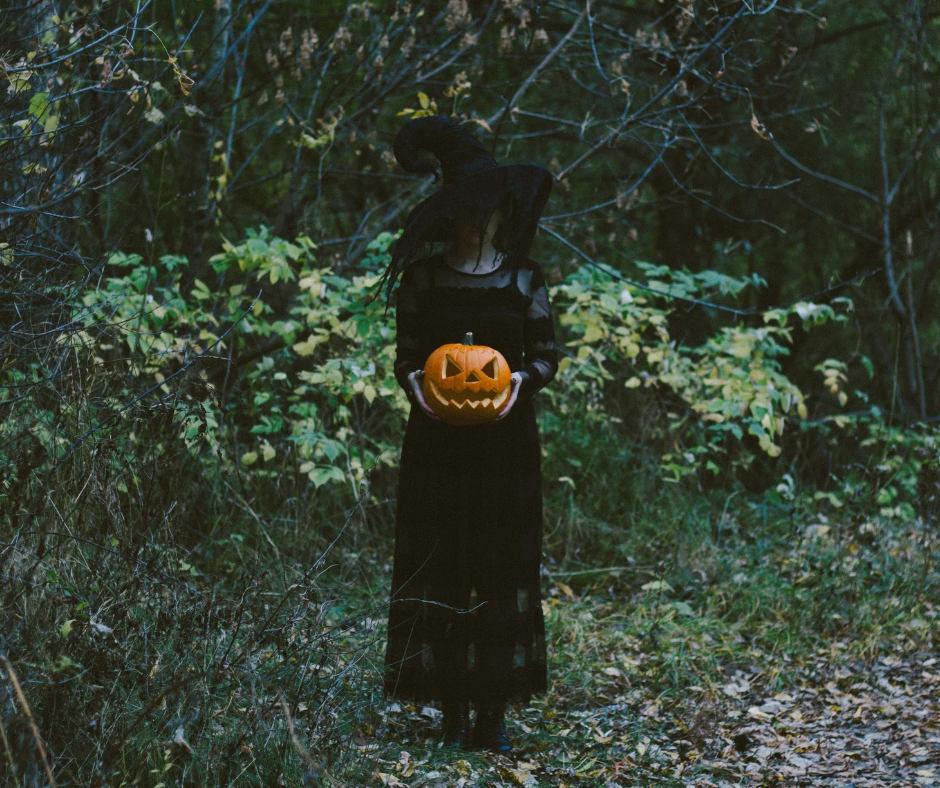

The veil is thinning, Poets.
The light is shifting. The cold is creeping in, even here in Texas. The leaves are changing color: brilliant reds and burnt golds.
My neighborhood is haunted by skeletons on front porches. Every yard has become a plastic cemetery.
October reminds me that everything must die–but that death isn’t necessarily the end. Halloween allows us to indulge dramatically in the idea of the afterlife, in the possibility that there is more to this world than the mundane.
Or maybe it just gives us permission to put on costumes, eat candy, and enjoy our stranger impulses.
Poetry has long been a way for me to explore grief. In my writing and in my spiritual practice, I summon the dead to speak of things present, past, and future. I talk to my dead mom about my toddler son. I ask Plath and Sexton if writing about my mental struggles is ultimately an act of healing or indulgence. I ramble on about the weather while the spirit of an old lady from down the road passes through my living room.
We can channel the dead in more conventional ways. Sometimes we talk about memories; sometimes we remember the last thing we ate with a person we loved. That, too, is summoning, without the supernatural element.
This October, I encourage you to look at what is haunting you, Poet. Is it a past version of yourself? The ghost of an old relationship? Hopes you had to abandon? Fears you’d rather stayed in the closet?
In honor of the spookiest of seasons, I’ve put together eight poetry prompts designed to lead you deep into your own darkness. So light a candle to guide your way. Pour something warm for good cheer.
Let the witching hour begin.
1. I Am Haunting My Own House
What better to write about than a haunted house?
For this prompt, imagine that you are a ghost within your own house. Consider your family, pets, plants, furniture–all the proof of a life you once lived within the walls of your home.
What memories are you sharing? What have you left undone? What do you really think of that horrible armchair in the corner or the mismatched collection of coffee cups in your cabinets?
Bonus: Don’t tell us you’re a ghost directly. Let the tone and imagery speak for you.
2. A Love Letter to a Monster
I don’t want you to write a Halloween poem for a misunderstood vampire who just happens to be single and extremely hot. I don’t want a love letter to a modern-day Frankenstein’s monster with a fetching scar across his eyebrow and a sensitive soul.
Give me love poetry for the real monsters: the Headless Horseman, Old Shuck, the Beast of Gévaudan, chupacabra, mothman, banshee. Find what’s lovable in the creatures we haven’t romanticized to death in modern media.
And before you call me a freak for loving monsters (I’ll own it), this doesn’t have to be a romantic love poem. But if you can make me fall for a kelpie? Well, that’s a poem I want to read.
Bonus: For this prompt, I encourage you to research monsters from folklore, especially if you have a cultural connection.
3. Conversations with the Dead
Who do you wish you could contact this Halloween?
Pick a medium: tarot cards, pendulums, spirit boards. Perhaps a disconnected wall phone or an old walkie-talkie. You can even use text messaging as a format.
Now have a normal conversation with someone on the other side. Don’t ask what the afterlife is like. Don’t go over the last words you wish you’d said.
Stay in the mundane. Get your mother’s recipe for fried chicken. Ask your brother what his favorite Star Trek movie is. Ask your friend from high school if they remember the prank you pulled senior year.
Let the dead in this Halloween poem simply be human.
Bonus: How can you let us see the importance of the relationship with the deceased without telling us exactly what they mean to you?
4. Embrace Your Fear
Fear is an incredibly rich area for Halloween poetry (and for poetry in general). Fear fuels our imagination in powerful ways, often running away with our thoughts and feelings.
This poem is an opportunity to name your fear and to thereby strip its power.
Think of something that frightens you–something abstract. Is it being misunderstood? Letting your partner down? Failure? Aging?
(I’ve scared myself, dear reader. Yikes.)
Now give your fear a physical form. Perhaps it’s an object in your room or an animal outside your window. Perhaps it’s a person you see out of the corner of your eye.
What sensory details can you give us? How can you make us feel your fear without naming it?
Bonus: Be unexpected. Choose something not usually associated with your particular fear. (And don’t write about clowns, please. I might cry.)
5. The Burial
Halloween is the perfect season for burying our dead, Poet.
For this poem, I want you to think of what you need to let go of. Is it an expectation you have of someone else? A conversation you keep replaying in your head?
It can be something frivolous or serious. The point is, it’s got to be something that needs to die.
Write a funeral poem for the thing you’re burying. Get detailed: Show us the casket. Let us hear the mourners, if anyone else attends this particular funeral. Reveal the writing on the headstone for us.
Bonus: Write the poem itself as a eulogy to what you’re burying. Why did you hold on for so long? Why did you finally let go?
6. The Moon Looks Different Tonight
One thing I love about Halloween is how everything is just slightly off. We take the familiar and make it terrifying–or we take the terrifying and make it absurd. Baby dolls that happen to be zombies. Hot pink skeletons that scream when you approach. Killer clowns. Sexy witches.
But would you notice if something was actually not quite right? If a familiar room was arranged just a little differently? If a picture of your grandfather showed him with a new shirt on or a suddenly knowing smile?
For this poem, start with this line:
The moon looks different tonight.
Then give us a world that isn’t quite right.
Bonus: Resist the urge to explain why everything is off. Let us experience the strangeness alongside you.
7. A Witch’s Cabinet of Curiosities
I’m a practicing witch. I usually say spiritualist, but it’s Halloween, so I’m donning my correct hat for a change.
If you were to walk through my house, you’d know within moments that something witchy is happening here. Crystals litter every available surface; statues of guardian animals and skeletons lurk amidst picture frames and houseplants; packets of dried herbs and stacks of candles occupy the same shelf as my alarming assortment of tea; painted animal bones and prints of insects, crescent moons, and botanicals jockey for space along the walls.
But being a witch isn’t about having the right spell ingredients or a certain aesthetic. Being a witch isn’t about any one thing in particular, in fact. My definition is wildly different from yours, I’m sure.
So put on your witch’s hat and tell me what’s in your cabinet of curiosities. If you are a witch, show me your practice by showing me the objects you keep close. If you’re not a witch, pretend for a moment that you are.
Bonus: Let your objects speak for themselves. Let me get to know you through what I see, hear, smell, feel, and perhaps even taste if you’re brewing tea or baking snacks.
8. Where the Veil Thins
We often think of Halloween as the time when the veil between worlds grows thinner. Now is the time when we can connect to the dead. For some of us, that’s literal; for others, it’s figurative.
You don’t have to believe in ghosts for this poem. Instead, I want you to think of an instance when the past has felt almost present. This might center on a loved one, a familiar place, or simply a moment in time.
Take us there, Poet. Whether it’s in the form of a dream, a meditation on a photograph, or the recollection of an anecdote, show us where the veil thins for you.
Bonus: Play with time. Don’t be too concrete in your poem: Let the past and the present mingle in ways that feel surreal.
Tricks and Treats
Before you take your candle to a darkened gothic manor or go explore your local haunted cemetery, treat yourself to these tricks:
Play with perspective: You don’t have to write as yourself. Write a Halloween poem from the monster’s perspective. Imagine the costume you’ve picked is the real you. Go back in time to when you were a kid.
Lean into the darkness: Let your poems explore the cobwebby corners of your mind and heart. Not everything has to be beautiful or resolved by the time you reach the last line.
Give us atmosphere: This is Halloween poetry. Get spooky with it. Write a poem that feels like an ‘80s horror movie. Craft sensory details that make us feel how sinister or eerie a moment is, without using those specific adjectives.
The Witching Hour
Halloween is a time for witches of all ages to play. Let yourself delight in the season. Indulge your imagination in some fantastic, unexpected poems that you wouldn’t usually write. Eat a bowl of Halloween candy and wear a costume, even if it’s one you threw together at the last minute. Watch a scary movie you’ve never heard of.
Let yourself believe, for the witching hour, that ghosts glide among us. Let yourself believe that not everything stays buried. Look up at the moon and pretend you saw a shadow flying across it.
If, while you’re writing, you hear a knock at your door?
That might just be me, looking for candy. Or perhaps it’s something unexpected, waiting for an invitation.




This article was published on October 27, 2026. Written by: