Becoming the Fool: Four Steps to Starting Your Creative Writing Practice


We find ourselves late into the spring season now, Poet. This is a time of new beginnings: Seeds we planted in winter have blossomed. The trees are laden with glossy foliage and with flowers that will later bear fruit.
There is a pasture of cows behind my house. Every morning, I carry my toddler on my hip outside to say hello to the calves. Sometimes the calves roam together to the far edges of the pasture, far from the rest of the herd; other times, they tag dutifully along behind their mothers. My son, a baby himself, faithfully chants his morning mantra when he sees them: “Cows. Moo. Oh wow. Hi cows. Moo.”
At not quite two years old, my son embodies the spring in many ways. He is seeing the world through new eyes, daily. He is marveling at the mundane. He is stepping out with perfect faith—literally, as he’s just now gaining confidence in his gait.
The Fool mirrors this energy. The Fool is a card of beginnings—of seedlings pushing clear of the earth knowing they’ll bloom in time, of baby animals exploring the limits of their territory without fear, of toddlers discovering anew all the secrets of the universe sitting right on the surface of things.
Today, I ask you to embrace new beginnings as we take a look at starting a creative writing practice.
The Creative Energy of the Fool
The Fool is the first card of the tarot deck, assigned a zero to mark his place. This card embodies the innocence of the uninitiated. He is a spontaneous risk-taker who trusts the process, sometimes to the point of naivety.
This card is all about new beginnings, which reflects the start (or evolution) of a creative writing practice. Every creative endeavor begins with that first step into the unknown. We become the flower blooming in spring, even as we are the fertile soil nurturing that cycle.
Alternatively, you can think of the Fool as the protagonist in a story stepping out in faith into the unknown. Think of Bilbo Baggins leaving the shire. Think of Luke Skywalker blasting off from Tattooine. The initial moment of creation might have the headlong energy of one of these heroes: That first draft of a poem might arrive fully formed. Or maybe you’ve been struck by the most brilliant concept for a chapbook.
Other times, the beginning might be more tentative, even fearful. The trust is lacking; there is more of a focus on risk. What if this is a terrible idea? What if my writing isn’t good enough? What if I never get published? What if I’m wasting more time?
Let me whisper a secret to you, Poet: The universe does not want you to create from a place of fear. You are not required to be certain of where the path is leading you: All that the universe asks is that you shed your fear and start walking. Or, in our case, start writing.
First steps look different for everyone. For some of us, it’s outlining the themes of a poetry manuscript. For others, it’s typing out those first tentative lines of a poem on a blank page. There is no right or wrong way to begin. The important part is simply the act of beginning in and of itself.
The Fool Reversed: Blocks to the Creative Process
The Fool reversed carries a lot of meanings, some that may or may not apply to your unique situation. But for now, let’s focus on two things we’ve all encountered as writers: stagnation and distraction.
When we don’t allow ourselves to write—out of fear, out of an overabundance of caution, out of some idea that we’re not prepared—our creativity stagnates. Ideas that we were so excited about grow stale, coated by layers of dust and mildew. The shine of inspiration turns dull and uninteresting. We tell ourselves we’ll come back to a project, when we have more time, or we tell ourselves that the idea was never that good to begin with.
Distraction is another issue, one that sometimes comes in disguise. I need to research more about this, we think. I need to read more books in this genre before I give it a go myself. I need to take a class.
Productivity disguised as distraction is still distraction. It still misdirects our creative energy, if it becomes the central focus.
There are other distractions, of course: groceries and chores and work and all of the mundane acts of living. We find ourselves channeling the Fool reversed, quite against our will or sometimes without conscious thought.
The best thing for it, in my experience? Just write. Write a few lines on your phone while you’re making dinner. Let ideas percolate while you rinse out your hair in the shower.
The Fool represents creation, born not from mastery but from forward movement. Take the first step. And then the step after that. And then the step after that.
Pretty soon you’ll be amazed at just how far you’ve come.
Start Your Creative Writing Process
You might have heard of the Fool’s Journey before if you’ve worked with tarot. Essentially, this is the narrative framework that follows the twenty-two major arcana: In the guise of the Fool, we step from our place of beginning through each of the stages of the major arcana. We experience the universal journey of personal development and spiritual evolution on the ups and downs of this path.
You can think of your creative writing practice as a Fool’s Journey of sorts. You’ll encounter different archetypes and energies as you give birth to a manuscript (or even to a single poem, perhaps). You’ll experience triumph and setbacks, alignment and rage, destruction and rebirth. You’ll learn things about yourself and the world around you. You’ll evolve, as will your writing practice.
There is no set order for how you will experience the markers of the Fool’s Journey, which reflects the fact that not all writing projects go as expected. Some flow smoothly; others hit creative blocks; some get lost in the spiral of revision. Creativity is to a degree universal, but each journey through the creative process is entirely unique.
But every journey shares one definitive feature: a beginning. So let us start there, Poet, and see where the path leads.
Step 1: Answer the Creative Call
Beginnings look different for everyone. In my recent BrainTrust on the Fool’s Journey, we explored four distinct types of beginnings:
The Fool: beginning from a place of naivety/faith
The Magician: beginning from a place of mastery
The Wheel of Fortune: beginning unexpectedly
Judgement: beginning as a form of awakening
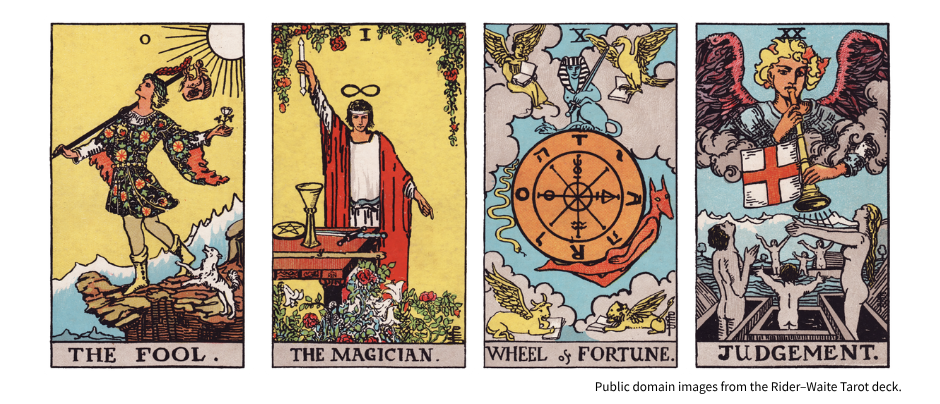
When it comes to intentionally starting a creative writing practice, we can channel the energy of any of these cards. But I’d like to draw your attention now to Judgement.
Judgement represents the amplification of the creative call that the Fool often heralds. This is your creative awakening. Judgement is about rebirth or of beginning as a form of evolution. Here is the moment where you take an intentional step forward.
The Fool asks us to step out in faith and uncertainty, while Judgement asks us to dive deeper: What are you meant to create? What truth do you need to give voice to? What are you here to express?
You do not have to have the answers to these questions before you put pen to the page. But for poets especially, sooner or later we find ourselves examining our poetry with a critical eye: What am I really trying to say here? Does this imagery convey my meaning? Are these empty signifiers? Does the lyricism evoke emotion? Am I creating connection or just noise?
As you commit to starting a creative writing practice, consider your purpose. What are you awakening to? Is this project meant to serve your most authentic self? To call out the atrocities of the day? To foster community in a disconnected world?
Self-reflection is a critical first step in this process.
But be wary: The self-reflection of the Judgement card can quickly slide into the self-doubt of Judgement reversed. There is a world of difference between being aware and being too aware.
Critical evaluation is a necessary part of writing. Editing is part of our process; revising is part of the journey. So being aware enough to question your choices is positive; that in and of itself pushes you forward on the path of creation.
But the stumbling blocks arise when you let your scrutiny entirely dismantle your writing—or when you turn a critical eye on your self rather than your work.
Judgement is here to signify that you have awoken to your calling as a writer and that you are embodying a deeper purpose: On the path to becoming, you are exactly where you are meant to be.
Step 2: Develop Your Craft
The Magician can be a starting point, especially if you are beginning a journey from a place of mastery. If you’re an expert in a particular field, a related project embodies Magician energy more than the energy of the Fool.
But the Magician’s mastery is one that we can cultivate in many ways, regardless of where we are starting from. When you launch a creative writing practice (or restart one), you are calling on the Magician as you develop your craft. This is just as true for established writers as it is for novices: We are all evolving as writers. Each revision or new draft is proof of that.
In the major arcana, the Magician follows the Fool; he takes the Fool’s ideas and shapes them into recognizable forms. Through focused skill, the Magician transmutes inspiration into intentional creation. If the Empress encourages us to let creativity flow our way effortlessly, the Magician asks us to use all of the skills and resources at our disposal to shape that flow.
As writers, our skills are synonymous with craft. Craft is the life’s blood of your creative writing practice. Inspiration isn’t enough to sustain the writerly life, nor is merely showing up to the page; these aspects are necessary, but they don’t move our writing forward in a way that meaningfully answers the creative call.
As part of your commitment to a creative writing practice, developing your craft is the next actionable step I want you to take. Show up with intention: Buy a book on poetics, not just another collection of poetry (but buy that, too!). Join the Feedback Circle at The Poetry Lab to improve your revision skills and to engage with other writers. Hone your voice by paying attention to your line breaks and word choices. Write drafts that push your creative skills. Revise. Revise again. Listen to what poets have to say on podcasts about the act of writing.
The Magician is a master manifestor. But think of this card as manifestation through effort. The universe does not expect instant mastery. Instead, it expects continuous effort.
Especially if you are new to writing, take the Magician as a signal to gather your tools and put them to use. Put your language, emotion, and imagination to work. Refine your craft with each step of your journey.
Step 3: Nurture Creative Inspiration
As an artist, I cannot stress enough how critical it is to nurture inspiration rather than to simply await its arrival.
We can turn to tarot to map out inspiration for our creative writing practice, specifically to the Aces of the minor arcana:
Ace of Wands: passion, creative spark
Ace of Cups: emotion, connection
Ace of Swords: clarity, insight
Ace of Pentacles: motivation, tangibility
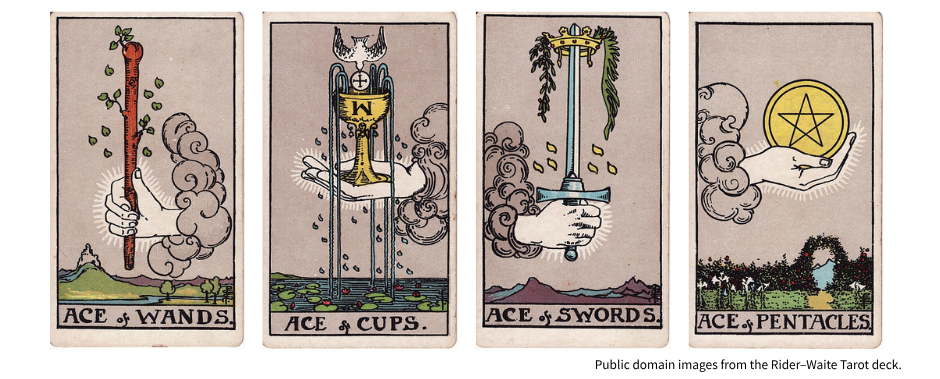
Each Ace serves a different purpose and requires a different invocation. You may find yourself drawn to one form of inspiration in particular, or you may rotate between them as your project/poem evolves.
The Ace of Wands represents the inspiration that jumpstarts your creativity. This is the idea that arrives fully formed at three in the morning or the rush of urgency that carries you through the first drafts of several new poems.
We can invite the Ace of Wands to our creative writing practice by free writing and journaling ideas as they come to us. Prioritize your creativity and treat inspiration as worthy of your time.
The Ace of Cups is tied deeply to the expression of emotions and to the connections we form. In my grief work, I find that I often write from this place, as my emotions yield to creative inspiration. This particular type of inspiration often feels like a sudden overflow, one that is cathartic to release in the form of poetry.
Let the Ace of Wands help you process whatever emotions you’re currently carrying. You can invite its inspiration by letting meaning emerge through imagery and connection. Don’t bind yourself to a specific outcome with your writing; instead, let inspiration lead you forward.
The Ace of Swords brings inspiration in the form of clarity. When you realize what you’re actually trying to convey with a poem, that’s the Ace of Swords at work. It can also help you to cut through blocks in your creative writing process
Cultivate this inspiration by exploring craft, as the writing techniques you learn will help you refine your language and define your focus.
The Ace of Pentacles is the inspiration that carries our work from first draft to finished product. This card can represent opportunities and can motivate us to bring our ideas into the real world.
When you do the serious work of revision, you’re channeling this inspiration of the Ace of Pentacles. You nurture this energy every time you submit a piece to a contest or publication. The very act of intentionally creating a structured writing routine is aligned with the Ace of Pentacles.
Wherever you’re at in your creative writing practice, be sure you cultivate inspiration in its various forms to carry you forward on your journey.
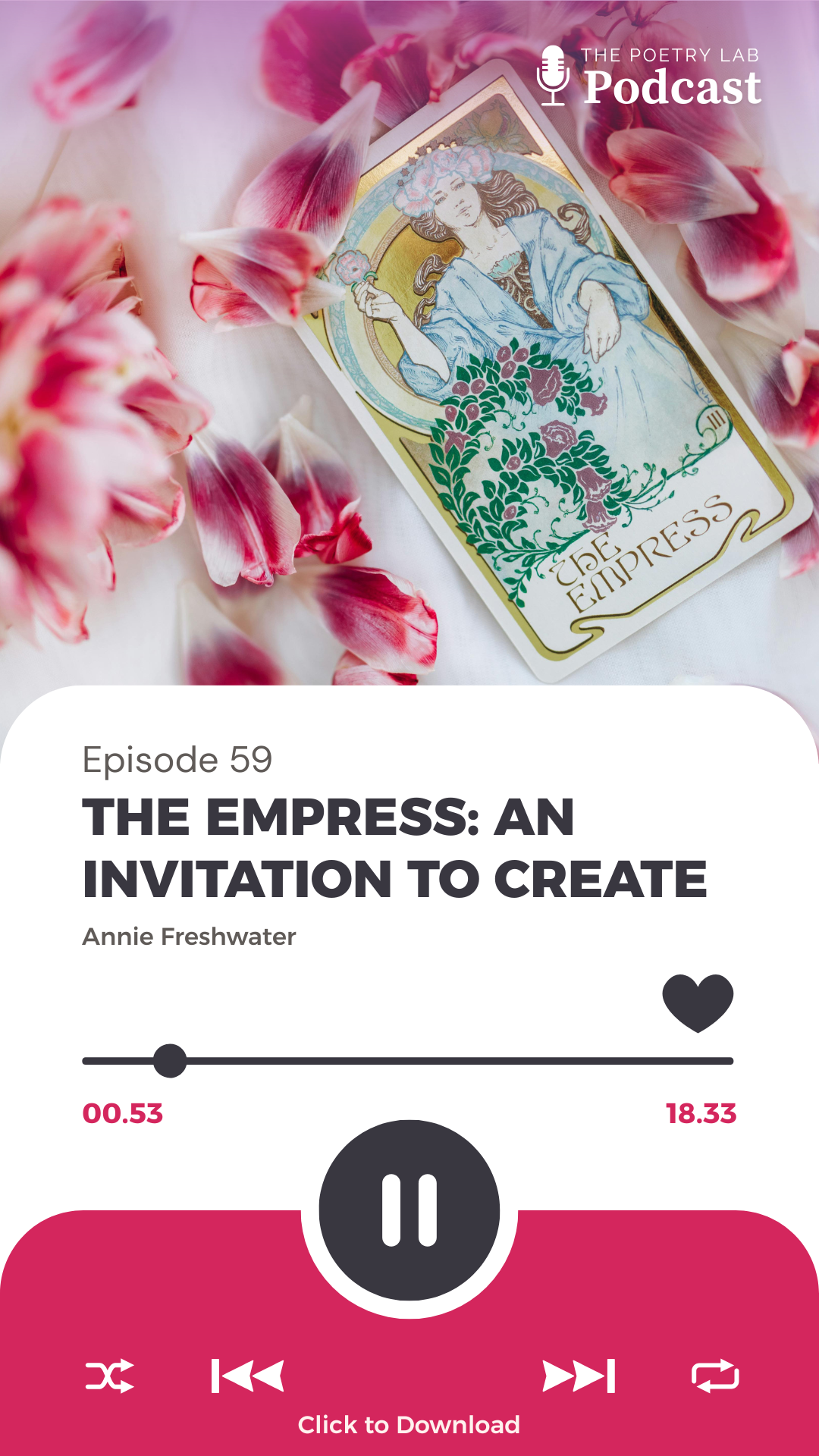
For another approach to inspiration, you can listen to my podcast episode on the abundance of the Empress.
Step 4: Stay Hopeful
Embodying the Fool requires courage. And sometimes, it requires childlike faith that each step on the road ahead will appear beneath our feet.
But faith and courage alone cannot carry us forward. Especially in the current climate, we must cultivate hope—for the present, for the future, for ourselves, for our communities, for our world. For that, we turn to the Star.
In the major arcana, the Star comes to light after the Tower’s moment of destruction. It is a card of renewal, healing, and purpose. In many ways, it is a softer reflection of Judgement’s awakening.
Appearing as it does after the despair and turmoil of the Tower, the Star holds space for our truest self: This card serves as a recognition that we have overcome immense odds and peeled off beliefs and patterns that no longer serve us. We catch a glimpse of our reflection, and we finally like what we see. We are guided by the Star’s light, and we know that the path we are on really does lead somewhere.
Poetry often flows from an open wound. We write about our personal traumas. We write about the world’s pain. We process our emotions and experiences word by word. Sometimes we heal. Sometimes we rediscover purpose or beauty. Sometimes we connect with the reader on the other side of the page, bearing the same wounds as we do.
Even in the midst of agony—the deep agony of healing and of naming our wounds, the lesser agonies of revision and publication submissions—the Star shines as a symbol of hope. Push on, the Star says. Inspiration will come back to you. What you are writing matters.
The Star is the universe’s way of honoring how far we’ve come and how much we’ve lost, while reminding us of everything good still to come. When we write from this place of hope, anything is possible.
Beginning Again…and Again…and Again
Let me drop a final card of beginnings, Poet, the last of the major arcana: The World. The World card represents the completion of a cycle. And yet when the Fool reaches the end, he does not rest: He walks right off of that precipice and falls off of the face of the earth, to land at the start of a new journey—or perhaps to land back where he first began, if he didn’t learn the right lessons.
You may be new to writing. You may be returning to the page after many years of silence. Or you may be an established writer. Wherever you’re starting from, intentionally establishing a creative writing practice signifies to the universe that you are ready to start the journey. You are committing to your writing, even when inspiration runs thin, even when the outcome is veiled.
And that is something worth celebrating.




This article was published on June 9, 2026. Written by: