Crafting a Creative Vision Board: Five Steps to Manifest Your Next Becoming

-
📌 What to Put on Your Vision Board
1️⃣ Step One: Release What No Longer Serves You
2️⃣ Step Two: Listen for What Wants to Emerge
3️⃣ Step Three: Gather What Resonates, Not What Makes Sense
4️⃣ Step Four: Arrange as an Altar, Not a To-Do List
5️⃣ Step Five: Let the Vision Board Change You—and Let the Vision Board Change

The holidays are over. The new year has arrived. We have put away the decorations (well, most of them) and switched to our usual playlists. We have made questionable progress with our resolutions, or perhaps some of us have really been sticking to those breathless promises made in the dead of winter.
We are showing up, each day, as the wheel of the year turns.
What do you want to actualize in 2026? What do you want to grow in your inner garden? 🌿
Creativity flourishes in all manner of ways (just check out our recent article on journaling to see what I mean!). I know writers who paint, bake, craft, dance, or even interior decorate when they’re not putting words to the page. Getting playful and messy with your creativity is an incredible way to stay present and charged.
But creativity can also help you manifest that goal list sitting in your planner or lurking in your head.
Let me tell you all about why a vision board might just be the secret for unlocking your most creative self this year.
Why a Vision Board?
Vision boards often get dismissed as aesthetic collages or goal-setting nonsense, dressed up in an excess of glitter and frivolity. But when we view a vision board through a spiritual lens, it becomes something much more powerful: a tangible way of seeing.
Creativity does not begin with action. It begins with attention. And a vision board invites us to pay attention to what we want to conjure into being.
Because a vision board represents a moment of alignment between desire and belief, it is a manifestation in and of itself. By creating one, you give shape and movement to your goals.
Vision Is Not Control
One of the greatest lessons I’ve learned as a student of tarot is that the future cannot be forced. Vision—whether it’s a vision board or an act of divination—is not about insisting on a specific outcome. It’s not about effort.
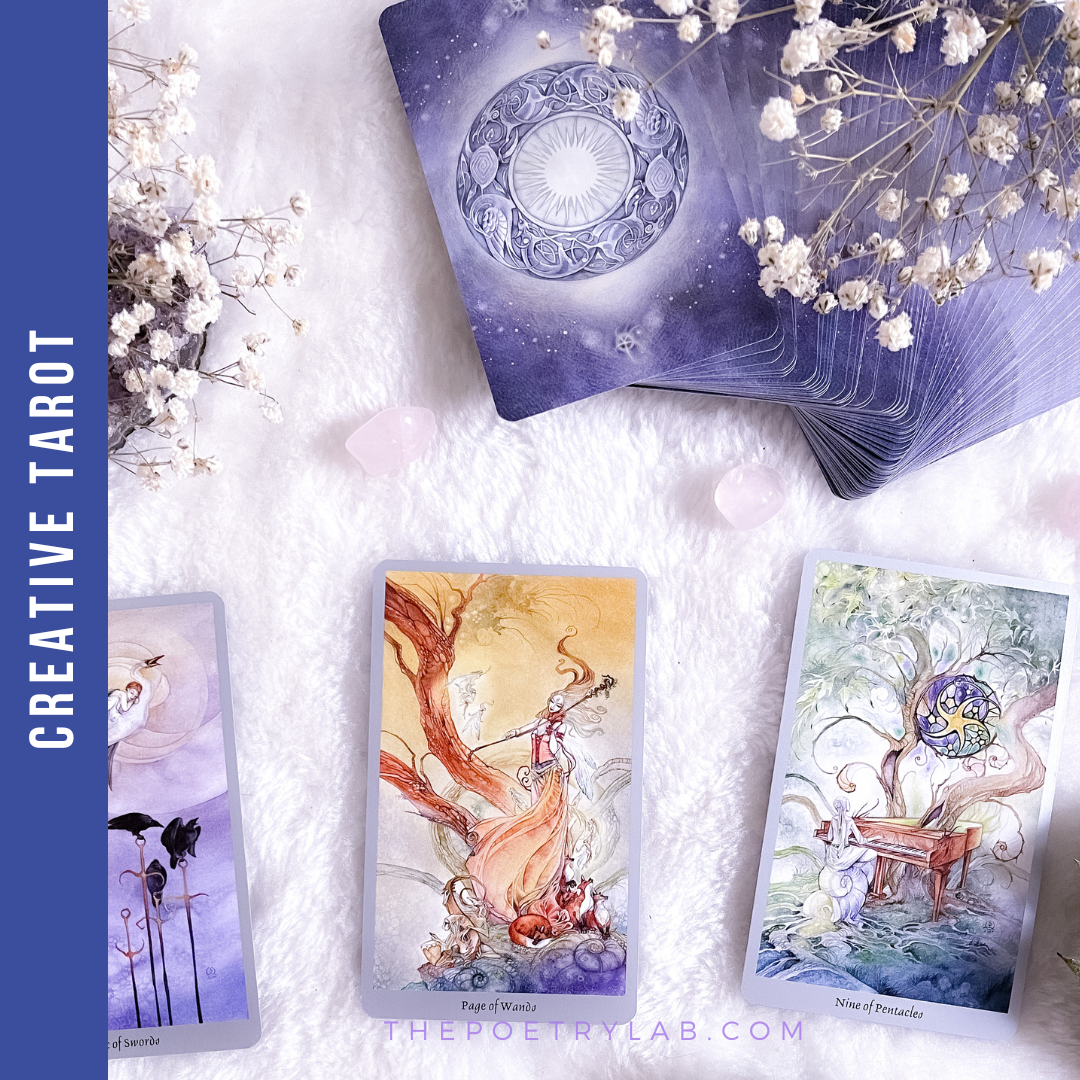
The High Priestess embodies the kind of vision board I want to encourage you to create. She is a card of receptivity, of listening, of waiting with intention. The High Priestess allows the universe to speak to her before she preemptively attaches meaning to the symbols around her.
A creative vision board isn’t a mechanical exercise in demand. We aren’t treating the universe as an ATM or an online ordering service.
Instead, we are embodying the receptivity of the High Priestess: We are inviting the universe to join us on a specific wavelength. Through the words and images we put on our board, we are directing the flow of our attention to the story we want to be part of—and the universe can respond by directing her energy in kind.
What to Put on Your Vision Board
A vision board is part mirror, part magnet. It’s a visual and tactile language that you can use to speak your goals into existence.
In the past, I’ve had vision boards that fall totally flat because I created them with a rigid expectation of outcomes. I’ve since learned that they are more about energetic embodiment and resonance.
A vision board can be as creative or utilitarian as you choose to make it. You can use a massive poster board and every crafting supply imaginable, or you can utilize an app like Canva. There is no right or wrong way to do this.
You can include almost anything that speaks to the vibe you want to curate:
Images: Photographs, magazine clippings, printed artwork, or sketches that evoke the feelings, environments, or experiences you want to draw closer
Words + Phrases: Quotes, affirmations, single words, lyrics, or lines of poetry that capture an intention or explore a mood
Textures + Objects: Fabric swatches, pressed flowers, ticket stubs, tiny charms, tarot cards, or anything that carries meaning/memory
Color + Symbol: Scraps of colored paper, splatters of paint, or scribbled symbols like runes or stars that resonate with the motifs you want to attract
A vision board isn’t about making a pretty collage for social media, so don’t prioritize aesthetics over feelings. This exercise is about creating a physical manifestation of your attention: Each element should speak to a facet of who you are becoming. It doesn’t need to make logical sense as long as it draws your focus, inspires your imagination, or elicits a visceral emotional response.
Think of your board as a living landscape: The images, words, and objects you choose are seeds. You are planting them with attention, creativity, and care. Some seeds bloom quickly, some slowly, and some in totally unexpected ways.
The choices you make are the foundation for the deeper work of the vision board. They prepare you to move into the steps ahead with clarity and intention.
Giving Yourself Permission to Receive
Despite the calendar change and all of our best resolutions, many of us are carrying burdens into 2026 that, frankly, do not serve us.
Burnt-out goals. Half-actualized plans. Unfinished stories. Exhausted identities. Patterns that once protected us but now only wound.
Poet, I am tired. But the world keeps shouting at me that I must push on before I can earn my rest—that I cannot access joy without justification, that I cannot receive unless I first prove my worth.
But manifestation does not begin with striving. Joy doesn’t arrive when we doggedly cling to something that has long since quit serving our greater good.
In truth, we need to begin with release. It’s time to set down the heavy things you’re holding on to as the first step of creating your vision board.
Step One: Release What No Longer Serves You
In a culture obsessed with momentum, letting go is often framed as giving up. We worry that releasing something—no matter how joyless or painful—means starting over, falling behind, or admitting failure. So we cling to the familiar, even when it is quietly draining us.
But symbolically, release is a form of completion.
When we release what no longer serves us, we allow ourselves to recognize that something has given us all that it can. That a role, belief, habit, or season has run its course and served its purpose in our life.
Endings can feel like abandonment or brick walls. But even a sudden ending—moving on from a project you were once excited about, leaving a relationship you really believed was meant to last forever—can be a type of completion.
In tarot, the Judgement card of the major arcana asks us to acknowledge the full story, that we might bear witness clearly enough to let it rest. The Fool invites us to release the certainty of what was so that we might make room for the uncertainty of what comes next.
Ask yourself: What story has been told enough in your life? What known path are you ready to leave behind?
Giving yourself permission to let go is the first step in creating a vision board. Think of it as preparing the soil for what you want to grow this year: To make room for new seeds (or to nurture the flowers you want to bloom again from seasons past), you first have to weed.
This type of release doesn’t require force or effort. The universe isn’t asking for destruction.
Name what is complete and set it down gently, as a form of closure.
Release can be as simple as affirmations spoken aloud:
“This version of me is tired.”
“This way of working no longer sustains me.”
“I don’t need to carry this into the next chapter.”
Step Two: Listen for What Wants to Emerge
Once we set something down, a space opens up inside of us. You might feel discomfort at the sudden lack; you might feel a disquieting sense of uncertainty. Or you might feel relief at the sudden quiet, the sudden ability to breathe.
The space is a threshold that we will soon cross as we gather up images and words for our vision board. There’s no need to race across it. The silence and uncertainty are an invitation to pause and listen.
Remember that the High Priestess is a symbol of receptivity. She also represents hidden knowledge: Her wisdom is veiled.
Similarly, vision does not arrive to us fully formed. We must be receptive to the glimpses we receive in the form of symbols, dreams, recurrent patterns, half-glimpsed truth.
Listen without attachment. Let yourself rest for a moment. Bring your attention to your body, to the steadiness of the earth beneath you.
Now imagine something approaching, slowly, without urgency. It doesn’t need to be named or given form; instead, focus on the feeling it creates in you.
Notice how close it comes before your body responds. And notice that response: how you soften and breathe in this moment of openness.
Listening doesn’t require reaching. What is seeking you will come to you, willingly. You don’t need to reach for it. You’re allowed to let it come to you.
Notice what keeps returning to your thoughts. What feels magnetic, even without clarity? What stirs emotion, without explanation?
Attune yourself to the universe. Let curiosity replace certainty. Let instinct lead where logic cannot.
Step Three: Gather What Resonates, Not What Makes Sense
A vision board is a vibe, not an outcome. We are reflecting on who we are becoming, without prioritizing coherence or practicality.
As you collect images, words, textures, or colors, let instinct continue to lead you. Choose what pulls at you, even if you don’t understand why.
What feels charged with unspoken intention? What makes your chest tighten? What lingers in your mind’s eye when you move on to another task?
Your vision board isn’t a resume or a five year plan. It’s a reflection of your inner landscape in the current moment, reaching towards a future feeling. It’s a liminal space that exists between the present-you and the future-you.
Do some images feel contradictory? That’s okay. Are you crafting something impractical, perhaps even a total fantasy? That’s also okay. Even if things don’t align with who you think you should be (as opposed to who you want to be), let them find a place of belonging.
In working with tarot both as a self-reflecting mirror and as a divination tool, I have learned that the symbols resonate long before meaning surfaces. If something catches our attention or keeps speaking to us, we’d do well to pay attention, even if we don’t yet understand the underlying message.
As you craft your vision board, prioritize symbol over logic. Let the Moon card of the major arcana guide you as intuition illuminates the path ahead: The light may be dim, but it is there for those who seek it.
The Moon can also indicate anxiety, fear, and illusion. Acknowledge those feelings if they appear as you manifest your vision—and release them.
Trust your vision. Trust what appears.
Step Four: Arrange as an Altar, Not a To-Do List
When it’s time to assemble your board, don’t ask:
What do I want to accomplish?
What do I want to obtain?
What do I want to achieve?
Instead, try:
What environment allows me to create?
What do I want to feel?
What reflects my energy?
Think of your vision board as an altar, rather than as a list that needs to be checked off. Let it be a sanctuary that invites abundance, beauty, creativity, pleasure, and grounded safety.
The Empress is my favorite tarot card. This year, I am seeking to actively embody her energy, especially as a creative. I’ll be sharing more about her in a future offering (stay tuned!), but for now I’d like to delve into her as a symbol for effortless abundance.
The Empress invites us to flow from a place of nourishment and fertility. She encourages us to nurture our senses and enjoy life in all of its beauty and pleasure—not as an act of indulgence, but rather as a radical form of self love.
When we take care of ourselves—when we craft a vision of the future that nourishes our mind, body, and soul—we give ourselves the resources we need to tap into the creative energy of the universe.
Let the Empress be the overseer of your vision board. Don’t limit yourself or dream from a place of scarcity Instead, manifest from a place of abundance.
The Empress represents the cyclical nature of life. To that end, don’t think in terms of timelines or concrete outcomes. This is a vision board for 2026, yes; but it’s also a vision board for a much greater becoming, one that extends beyond our meager concept of time.
Step Five: Let the Vision Board Change You—and Let the Vision Board Change
A vision board is not finished when you glue down your last image or scribble a final quote. Much like a tarot reading, meanings deepen and new symbolism appears as time goes on.
Return to your vision board periodically or place it somewhere that you can see it out of the corner of your eye when you pass by. Ask yourself: What feels closer? What do I feel taking root?
Let the vision board serve as a manifestation to bring about changes in you; and as you change, don’t be afraid to adjust your vision board. If something no longer belongs there, remove it without guilt. Rearrange your vibes, themes, and goals without apology.
The Empress gently reminds us that change comes in cycles. We have periods of creative fertility and periods of rest. Similarly, the Wheel of Fortune reinforces that life is in a constant state of flux. To see change—real, lasting change—we must embrace that.
If you feel like you’re stagnating, that’s valid. But before you scramble to force forward progress, consider the Hanged Man: He teaches that pause is not failure. Sometimes, we must let time pass so that good things can grow. Sometimes, we must let ourselves rest or simply hold space for who we are becoming
Seeing as an Act of Faith
A vision board can be a powerful tool for manifestation. But, much like tarot cards, a vision board is ultimately an exercise in reflection.
Your vision board asks you to trust the intuitive thoughts, symbolic patterns, and landscape of your under world before they make sense. Trust that what you are drawn towards is meaningful. Trust that your creativity belongs, even when it does not equal productivity. Trust that what you are seeking is also seeing you.
When you do a tarot reading, you become an active participant in your vision of the future. The same is true when you create a vision board: It is a tangible act of faith that your becoming is not in vain.
Lean in to your curiosity and your creativity. Shrug off the sense of urgency. Leave behind your preconceptions and expectations.
Just listen, with your whole heart wide open. In that stillness, you allow yourself to connect with what has been waiting for you all along.


This article was published on January 20, 2026. Written by: