Six Journaling Prompts to Turn Daily Practice into Poems

I am a sincere believer that practice makes poems. I consider myself a poet not because I have written poems, but rather because I continue to engage in the process of writing poems. It is the process that I love, that keeps my wheels turning, my gears grinding, my lights flickering on and off. As much as I am pleased with any ‘finished poem,’ it is the poems I have yet to write, the ones I am currently writing, that drive me as a poet.
Over the years a big part of that process continues to be journaling. And I don’t mean documenting what I had for breakfast, and not because I didn’t eat breakfast, I mean journaling as a creative practice.
I have been a journaling girly who junk-journaled since I was a pre-teen, before I even knew what junk journaling was. Journaling was how I learned that I loved to write poems for myself. My parents had signed me up for a summer art camp at MOLAA (the Museum of Latin American Art in Long Beach, California) and we did a week on making journals. I made as many as I could. It wasn’t the journals themselves I was so excited for: it was figuring out what I would discover as I filled the pages. Our instructor had shown us his journal, and the magic it beheld was a revelatory moment in my nascent days as a multi-modal creative. It was like ah-ha! That is how art is made! But I had no idea what kind of art I wanted to make, and so I filled and filled those pages the rest of the summer with all kinds of trials until I happened to write a poem. A poem I immediately had to start re-writing, a poem I could hear as I was writing it. A silly poem about lovers who had been separated by an ocean, a silly poem that I wrote for no reason besides the desire to do so. It is this process of self-discovery that has kept me journaling all these years later.
As a multimodal creative who was always playing with markers and glue and stickers as part of my creative practice, journaling has been quite natural for me. From that first summer art class to now being in the era of TikTok and Instagram tutorials it has been a welcoming and low pressure space to just play. Though the practice itself is kind of a solo-act, learning what others are trying out helps to super charge my imagination with what else is possible! When I am journaling the pressure ‘to write a poem’ disappears–though I may hope to garner some insights and ‘poem nuggets’ for future completed pieces–journaling as a practice is a truly liminal and inviting space. Journaling is a way to fill the pages simply for the act itself. No other audience is ever expected to view these pages (though on occasion I do share with friends, I consider that a bonus and not my norm), and this privacy can be so liberating, especially in our modern surveillance age.
Journaling is so natural for me I can sometimes forget that it can be quite bewildering for those new to the practice, and this got me excited to share some of the prompts I use in my own process. In my ideal world I want everyone who has the creative inkling to try journaling, to feel empowered with the tools and toys they need to make play freely. To feel their own special kind of magic. I am always taking things I’ve learned and trying them out, often for the first time, in this creative space. The finished results are often personal and intimate. Though I love finished poems and paintings, they don’t always hold the same texture as something as personal and intimate as one’s own journal can hold. And I do mean literal texture, like glitter and folded pages and spill marks and crusty paint–all of these disappear in the realm of traditional publishing. So I find there is a lot of value when it comes to understanding our own voices, and again journaling dissolves much of the anxiety or pressure that can be involved when getting poems ready for submission.
So if you have ever wanted to try journaling for the first time, or like me, are always looking for something new to try, consider this your invitation to join the party! Here I will share 6 different prompts I use again and again in my journaling practice.I hope you find something that inspires you as well.
6 Low-Pressure Journaling Prompts
Explore Someplace New 📍
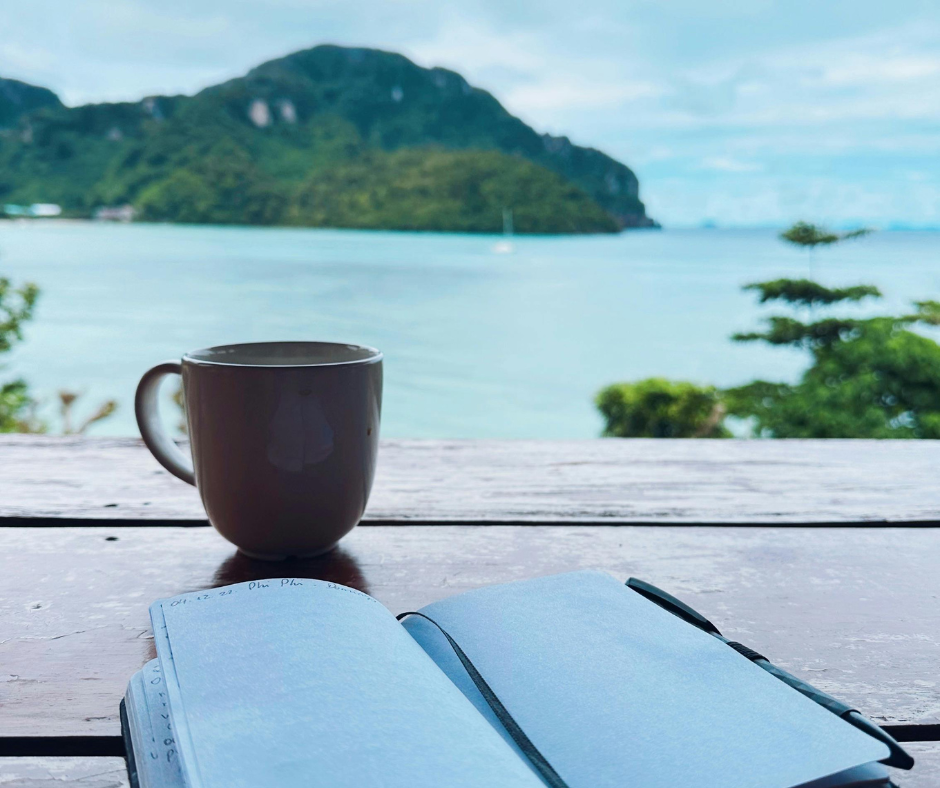
Journals make great travel buddies, so this first prompt involves a field trip! Take your journal on an adventure to someplace new. Taking our writing practice out into the world can be a fun way to explore: whether you go to a new restaurant, or sit at a new bench at the park, take the time to soak in all the sights and smells around you. Write an immersive page by focusing in on your five senses. I learned to make grounding lists from a former therapist of mine to help cope with anxiety attacks, but I love it so much I use it frequently for poetry as well. Write down 5 things you can see (bonus if they are 5 different colors), 4 things you can hear, 3 things you can feel 2 things you can smell, and 1 thing you can taste. Now try the list backwards, 5 things you can taste, 4 things you can smell, 3 things you can feel, 2 things you can hear, and 1 thing you can see. Try this anytime you want to write about a new place.
Getting Messy 🎉
Journaling can get three dimensional! Spend the week collecting odd bits of paper that hold some kind of meaning for you. Whether it be a receipt with all the ingredients for a special meal, some packaging you like the color of, a brochure from someplace you visited.. then when you have enough ephemera get a glue stick and tear up the receipts, packaging, etcetera and glue the bits down on the page. This is called junk journaling, and it is about getting messy and making art from everyday materials. We don’t need fancy supplies to make art, just a desire to make it. After you’ve finished your collage, write an accompanying list poem. Example lists could be ‘Things I dream about in the fall’, ‘Recipes of food I no longer eat’ or ‘Events both on and off my schedule.’ It can be a list about anything that occurs to you at that moment. Consider implementing parataxis by creating a list with no hierarchical order.
Shapes and Sounds 🔊
Typing poetry comes with constraints. From left to right, top to bottom, these choices have been automated for a digitized world. Playing with a journal makes it easy to try approaching the page differently. We can write in all kinds of shapes. For this prompt choose three objects smaller than your journal so that you can trace these objects onto your page. The shapes can overlap and you can trace them more than once. Now use the boundary of the traced objects to write inside and outside of. Try following the shapes so your lines don’t go from left to right across the page but perhaps spiral the inside of a circle created by the bottom of your favorite coffee mug. If you are interested in concrete poetry or familiar with Diana Khoi Nguyen’s book Ghost Of this is a great way to explore the ways words can shape images through their forms and not just their meanings. Pro tip: try writing with something besides your usual pen or pencil. Maybe try crayons or lip liner. Maybe try dipping a paintbrush in your coffee and use that as your ink. Get creative, there are mysteries to unlock.
Complete the Page 📃
If your journal is anything like mine there are plenty of unfinished pages. Pages where I was interrupted or lost the thread. Ideas maybe that only took up a small space and have a little room left. This is a choose your own adventure prompt! Flip through your journal and find one of these unfinished pages. Take a moment to reflect on what already exists on this page. Next fill in the blank space with details from an alternate universe. At least one of these details should appear as a doodle. Sometimes a blank page can create anxiety or an expectation; by completing an unfinished page with something entirely different, we can break open our own expectations and let go of any anxieties we may bring into our writing process. If you reach the end of your page, flip to a blank one and continue writing about this alternate universe for half the page, then turn back to your original topic and finish the page. You can go back and forth like this until you are satisfied with both universes.
Pillow Book 💤
This prompt was inspired by Sei Shōnagon’s “The Pillow Book,” which began the tradition of zuihitsu poetry. Keep your journal under your pillow for a week. Whether it be in the mornings before getting out of bed or in the evenings before falling asleep, or afternoon naptimes, try writing about your favorite things. Interacting with our memories is a powerful practice and in this prompt we will be enhancing our connection to the pleasurable. Spend time throughout the week documenting the things you love and enjoy. For example, what do you love about winter that is different from what you love about springtime? What do you love about evenings versus daytime? Was there a particularly charming memory you have from these times? Try recreating a short scene that depicts what you found charming. Infuse yourself with positive reminders as you wake up or fall asleep. Get subliminal and try noticing your dreams throughout this process: did anything you wrote about find its way into your subconscious? Write about it!
Drawing with Words 🎨
Look around your immediate vicinity and choose something to draw. Don’t worry about your skill level or trying to make it look good. Maybe you draw a window and the scene outside the window, maybe you draw your cat or dog, maybe you draw the microwave. Whatever it is, give yourself time to notice the details of what you are drawing. Maybe spend 5-10 minutes on this sketch. Then write a defamiliarization style poem where the image that you sketched is described without any of the words that are used to typically describe this image. Do not directly name the image. As you describe the image, consider the ‘emotional stakes’ of this image: why is it important or not important? Why is the image valuable or not valuable? How do you interact with this image? By both sketching and writing an accompanying poem you’ll be playing with both sides of Ekphrasis, that is poetry based on an image.
These are just dew drops of possibilities in the vast waterway that is journaling. Whether it hits you like the monsoon season or occasionally fills your cup, I hope these explorations give you permission to play on the page. Maybe you’ll write a short story instead of a poem, maybe you’ll have some wild dreams in the process; whatever it is, I hope that the experiential nature of journaling is a personal one for you. We at The Poetry Lab rail against the notion of a tortured artist: though we understand the world's agonies, we want the process of poetry to alleviate the burdens of life and not add to them. Even when tackling some of our roughest emotions a personal journal can provide the safety and room for our own voices to grow and groan and moan and keen freely, and without the added pressure of performance or the consideration of an audience. If there is one thing I hope to impress upon you it is that a journal is for you as an artist and creative and in a journal you get to make your own rules. Get messy, get wild, a journal welcomes you anywhere and always.
P.S. For continued study of journaling I recommend The Diary of Frida Kahlo and The Pillow Book of Sei Shōnagon.
/ related




/ upcoming classes
This article was published on December 12, 2025. Written by:
⭐Recommended in this article: