Disability Poetics: Eight Must-Read Poets for Disability Pride Month and Beyond

-
📕 Hannah Emerson
📙 Raymond Antrobus
📕 Naomi Ortiz
📙 Noa Micaela Fields
📕 Walela Nehanda
📙 Tarik Dobbs
📕 Leroy F. Moore
📙 Leah Lakshmi Piepzna-SamarasinhaRegister for The Word Works Better with Us: Disable Poetics Panel Discussion LIVE! July 28
This article contains affiliate links.
July is Disability Pride Month, a time to celebrate all of the different types of disabilities that make up the diversity of human experience. While a lot of people consider disability to only be about physical impairment, the truth is that disability can be physical, cognitive, psychological, developmental, sensory, and/or neurodivergence.
The 2026 theme for Disability Pride Month is “The World Works Better With Us” and is a call for disabled people to be included in the decisions that affect our daily lives. So many disabled people have limited access to services and equipment they need to live. There are accessibility barriers as well as the overwhelming stigma that insists that disability is something to hide. Disability Pride Month rejects exclusion and demands that disabled people be accepted for who we are and how we enter the world.
Disability Pride Month is in July because of the anniversary of the passage of the landmark legislation the Americans with Disabilities Act. That legislation was signed into law on July 26, 1990, creating a legal framework for disabled people to access public spaces in the United States. This includes requiring public buildings have wheelchair ramps, motorized doors, and accessible bathrooms. It also includes legal protection from discrimination in school or the workplace.
If you’ve never explored poetry about disability, Disability Pride Month is a great time to get started. You don’t need to be disabled to read these poems. The experiences of disabled people are relevant to everyone, whether you are disabled or not. I invite you to get started with some of the poems below.
Hannah Emerson (she/her)
Hannah Emerson is a nonspeaking autistic poet writing powerful poems using lyrical repetition. Her poem “Come Home” is a meditation on what it means to search for freedom. Words that are repeated are of particular interest and emphasis. One word that appears many times in different poems is “freedom”:
that freedom is the wild ready
trying to become the freedom
that is the kissing
freedom that we want
Her repetition of phrases provides emphasis and clarity toward the poem’s meaning. Her writing reflects an inner world filled with thoughts that trail from one pattern into another:
when we try to put your head on
the pillow and dream the wild
great great great freedom
that is the great great great becoming
the sun that is trying to give us
the light to see that we
help ourselves
Read the Poem: “Come Home” ↗
If you are interested in reading more of Hannah Emerson’s work, look for her poetry book The Kissing of Kissing.
Raymond Antrobus (he/him)
Raymond Antrobus’ poem “Dear Hearing World” is a stunning rebuke of the societal norms that allow Deaf people to be left behind. In it, Antrobus details many different ways that hearing people have abandoned Deaf people, including references to teaching practices for Deaf students that deny them language:
You erased what could have always been poetry.
You taught me I was inferior to standard English expression –
I was a broken speaker, you were never a broken interpreter –
“Dear Hearing World” is a poem that demands attention from the reader. Antrobus examines the impact of hearing on everything from classrooms to God. The poem both condemns the treatment of Deaf people and imagines survival beyond the conditions described:
I have left Earth in search of an audible God.
I do not trust the sound of yours.
You wouldn’t recognise my grandmother’s Hallelujah
if she had to sign it, you would have made her sit
on her hands and put a ruler in her mouth
as if measuring her distance from holy.
Read the Poem: “Dear Hearing World” [includes recording] ↗
If you would like to read more of Raymond Antrobus’ work, pick up his book The Perseverance, which won the Ted Hughes Award in 2019.
Naomi Ortiz (they/she)
Naomi Ortiz’ poem “Ode to Plastic Cups” investigates the conflict of environmental demands and disabled access needs. In their example, plastic cups serve as a stand-in for many kinds of environmental policies that don’t take into account the needs of disabled people. Ortiz flips the idea that plastic cups are always bad by listing all the ways that other kinds of cups fail them:
non-flexing elbow means arm
smacks cup across room with accidental gusto
at least once a week
Beloved coffee cups
shatter into h u n d r e d s of p i e c e s
must dredge energy to clean up now
It’s easy for environmentalists to demand a ban on plastic cups because of their lasting impact, but Ortiz asks us to look at it a different way. What if plastic cups are necessary for her to be able to drink safely? Or at all? She also interrogates her own role, and the role she is assigned:
I stock up, dollar store deals
just what works for my body
call it an accommodation
this need for plastic cups...
Where is my place in zero waste?
Poem: “Ode to Plastic Cups” [recording included] ↗
If you like this poem, check out Naomi Ortiz’ book, Rituals for Climate Change: A Crip Struggle for Ecojustice
Noa Micaela Fields (she/her)
Noa Micaela Fields’ poem “Echolalia” delves deeply into repetition in a poem filled with onomatopoeia. Echolalia is the phenomenon of repeating a sound immediately after hearing that sound and is often associated with neurodivergence. Short, choppy lines in this piece reflect the echo:
Drafts / drown in / throat. I’m / pssst tense
Assonance also serves a powerful function in this piece. When read aloud, the sounds roll into one another with a rhythmic flow. It’s almost as if the echo can be heard by the reader:
Trachea, / trace—translate / [hiss] chase
Poem: “Echolalia” [recording included] ↗
If you’re looking for more poems about experiencing sound, check out Noa Micaela Fields’ most recent book E.
Walela Nehanda (they/them)
In “Crip vs Crip,” Walela Nehanda interrogates the use of “crip” among disabled people. “Crip” has specific meanings that are different in Black culture than disabled culture. In this piece Walela navigates two parts of their identity: as a Black person and as a disabled person.
There goes that duality of language again,
the double entendre,
the one foot in and another out.
I’m just over here trying to jimmy open
the door to my imagination.
There are no easy answers in this poem, as Nehanda excavates etymology and examines how language requires context for meaning. Their crisp diction moves the reader through the analysis of the multiple meanings of crip.
In 2019, I saw the word crip
used by someone who didn’t bang on Twitter
—wondered if the hood was being appropriated yet again
Poem: “Crip vs Crip” [recording included] ↗
If you enjoyed Walela Nehanda’s poem, check out their memoir Bless the Blood: A Cancer Memoir.
Tarik Dobbs (he/him)
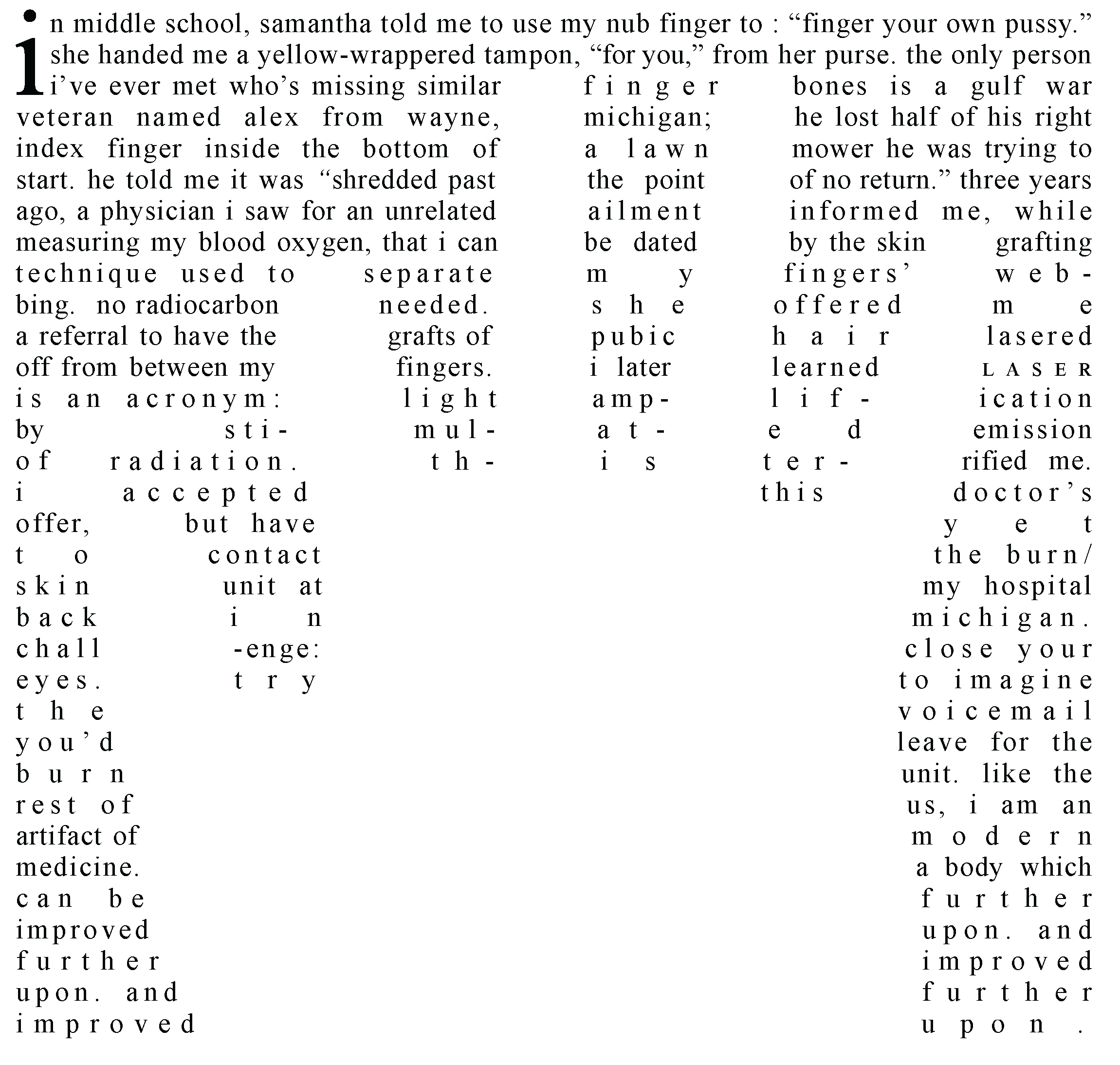
Poet Tarik Dobbs plays with space on the page in unusual and surprising ways. In his poem “nub,” he familiarizes the reader with his hand that has been badly burned. He arranges the words on the page around the shape of an open palm. The reader must carefully navigate the lines to learn about the speaker’s journey:
like the / rest of us I am / an artifact of modern / medicine
This kind of poetry can be called visual poetry or concrete poetry. In this poem, how the words are arranged on the page is as important as the word choices. The negative space of a hand on the page conveys the critical importance of the hand to the text.
Poem: “nub” [recording included] ↗
For more of Tarik Dobbs’ visual poetry, check out his most recent collection called Nazar Boy.
Leroy F. Moore (he/him)
Leroy F. Moore is a poet, activist, and artist who has spent his life creating opportunities for disabled people to be front and center. The founder of Krip-Hop Nation, Moore writes in a lyrical voice that begs to be read aloud. In his piece “Buried Voices,” he settles in at the intersections of race and disability to raise up voices that so often go unheard:
Blacks disabled boys can't grow up to be Black disabled men
Buried in mainstream news
Buried in the community
Can't breath, can't hear, can't see
This poem utilizes rhyme and assonance to bring the reader into the message. As Moore makes this piece come alive, he simultaneously mourns for those who have died. The depth of his dedication to advocating for others who are disabled is apparent in each stanza:
Buried voices
Are always with me
They are in my head guiding my penI write with the blood of disabled youth
Poem: “Buried Voices” ↗
If you are looking for more writing about how Black identity and disabled identity hold hands, Leroy F. Moore wrote a fiction book called Black Disabled Ancestors.
Leah Lakshmi Piepzna-Samarasinha (they/them)
Poet, author, and cultural worker Leah Lakshmi Piepzna-Samarasinha writes in detail about the realities of being disabled, including the mundane. In “I know crips live here,” they open up to the everyday objects found around a disabled person’s home. So often disabled people live lives that are seemingly secret and mysterious. In this piece, Piepzna-Samarasinha throws the doors open so anyone can take in the view:
That's the imprint of your ass in the couch surrounded by empty bags of food and plates and the Advil and the heating pad.
They use the repetition of “I know crips live here” to open every stanza, anchoring the poem in the setting. As the speaker moves through the house, they become more comfortable with the surroundings and describing them. The reader is left to decide if the speaker is describing their own home or someone else’s. Either way, it doesn’t matter. The poem’s invitation to the comfort of the space is apparent regardless of the interpretation:
I know crips live here.
Welcome
You are home.
Poem: “I know crips live here” ↗
If you enjoy this poem, check out Leah Lakshmi Piepzna-Samarasinha’s recently released book of poetry called The Way Disabled People Love Each Other.
I hope that somewhere among this list you’ve found a new poet to explore this July. Disabled poetry is not just for disabled people: We can all learn by listening to the voices of others who have different experiences than our own.
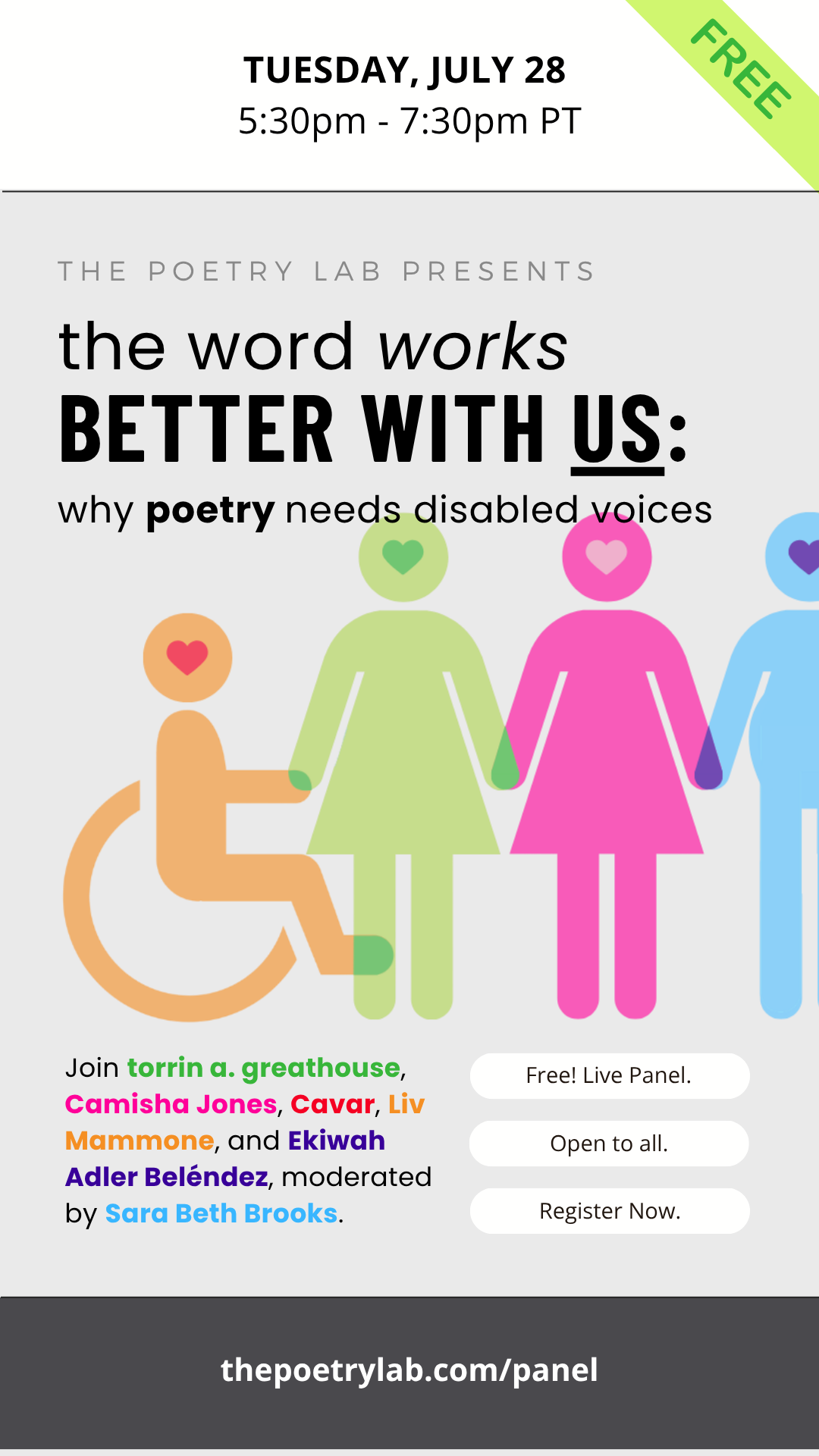
Later this month I will be hosting several disabled poets in conversation around the power of disabled poetry. Join us for this conversation called The Word Works Better With Us: Why Poetry Needs Disabled Voices on July 28, 2026, from 5:30pm-7:30pm Pacific Time. The panel is free to attend, but you do need to register in advance here.


This article was published on July 8, 2026. Written by: