Erasure in Process: Lessons on Play, Creativity, and Autonomy in Art
-
📌 The Darker Side of the Erasure Technique
📌 My Own Erasure Process
📌 Try It!This article contains affiliate links for Bookshop.org

In November 2025, I taught a Braintrust for The Poetry Lab called History of Power: Erasure as a Response to Political Unrest. During the session, we discussed how erasure poetry developed as a direct response to political erasure and explored how those who chose to engage with this technique were, in effect, using it as a means of reclaiming a narrative in which they’d been effectively silenced or removed. We can trace erasure poetry to several political movements and protests of today including the Holocaust, The American Civil War, the Ugly Laws, and even the recent genocide in Gaza.
We poets know that erasure poetry can take many forms, including blackout poetry (in some circles now referred to as “poetry of redaction.”), layered poetry, and cut-up poetry; however I was most interested in what this technique had to teach me about trusting my own poetic instincts. Let’s take a closer look at my deep dive.
The Complex Origins of Erasure
Erasure poetry is a subset of found poetry. The Academy of American Poets defines found poetry as a technique that “takes existing texts and refashions them, reorders them, and presents the new text as poems.” Material for found poetry is often sourced from everyday life with text coming from newspapers, court documents, letters, speeches, graffiti, and even corporate advertisements. Similar to the Dadaist and Pop Art movements of the 20th century, found poetry served as a means of “recontextualizing every day culture” and “challenging the notion of artistic hierarchy,” often through playful critiques.
In his essay “A Present Absence”, written for Frame Literary, Andy Zuliani asserts that the erasure process is largely imaginative, offering new kinds of attention and new modes of engagement that challenge the status quo. “These processes,” he writes, “offer new modes of navigating the disorienting surface.”
Additionally, the erasure technique allows for multiple meanings and perspectives to exist simultaneously. In his essay “Poetry Under Erasure” (published in Theory into Poetry: New Approaches to the Lyric), scholar Brian McHale argues that “erasure is both there and not there, admitted and excluded,” and poet Annie Dillard further confirms: “Turning a text into a poem doubles that poem’s context. The original meaning remains intact, but now it swings between two poles.”
The final published poem never exists solely in the form we receive on the page, but also within all the spoken and unspoken social codes currently within, and outside, our awareness.
The Darker Side of the Erasure Technique
My introduction to erasure was in learning that erasing is about reclamation, about revealing, about uncovering what has been kept from public view. That said, I would be remiss if I didn’t also consider that this technique has a darker side.
In her essay “Erasure in Three Acts”, Muriel Leung writes: “Tell me about disappearance and I will tell you about palimpsests. Everything we erase still manages to leave something behind.” She continues: “To be found is something akin to being discovered, which is the convenient trapping of saying something is new when it has already long existed. To make something new from these old bones will always be a political act, either to liberate the text from its original meaning or reinscribe the violence in another form.”
Furthermore, in their essay “The Near Transitive Properties of the Political and Poetical: Erasure,” Solmaz Sharif asserts, “Poetic erasure means the striking out of text. Historically, the striking out of text is the root of obliterating peoples.”
In other words, there is a fine line between reclaiming and re-traumatizing. When engaging with this technique, it’s important to consider whether one might be further silencing a voice that has already been silenced or doubling down—even if unintentionally—on the actions implicit in oppression.
Sharif writes: “The political is tactile and formal. It is enacted whenever power is at hand, power being at hand whenever there is a relation, including the relation between text and reader.”
You may be wondering, is there a balance between illumination and further censure? I think so. And I also think there are some parameters to consider before beginning. For the erasure process, you may want to:
Choose a work that you have mixed feelings about. One where you can argue against the style or position. Make sure it’s a source that you aren’t afraid to destroy or make a mess with.
Choose a work that has a different writing or visual style from your own (more on that below)
Choose a work where you can hear, sense, or witness an aspect of your own identity or story. Consider what the original author shared and what they left out. What aspects are still left to tell? Find those hidden stories under what’s been published.
My Own Erasure Process
Recently I engaged in the process of erasing the entirety of Jennifer Militello’s poetry collection Body Thesaurus. I chose to erase this book because I did not resonate with the poems and wanted to repurpose them. Here are three things I learned:
1. Consider your own work. Sources with similar themes but different writing or visual styles allows for multiple perspectives.
While I did not find Militello’s writing style personally compelling, I did resonate with the themes she explored: chronic illness, disability, diagnostic testing, and the trauma enacted on bodies by the medical industrial complex.
As a fellow poet with a disability, I often write about these themes in my own work, and so, because our themes were similar, I discovered, while erasing, that my own voice rose quite easily from underneath hers. Our voices were able to exist beside each other because, while our viewpoints may not have been the same, a connection existed regarding what we cared about, what preoccupied us, and the complex relationships we have with our bodies and the way environments act and interact with them.
In the past, when I’ve tried erasing the work of other poets, the process hasn’t gone as smoothly. I think it went easier this time because I was able to recognize myself and hear myself in Militello’s poems even though our writing styles are vastly different. I was able to sense an echo and expand on that echo.
2. Don’t be afraid to rearrange words and lines. Add visuals and pops of color, too.
Let your eye and ear collaborate. The standard process of erasure is to go line by line, in the order the lines are arranged; however, to find your voice, you must trust what you hear, and what you hear may be on the page, but at a different place in the poem. For example, the beginning of a line may be in the first stanza of a poem, while the end may be in the last stanza. It is okay to put the words in the order that works for your own intentions and message. Language is a learning tool, one meant for play, as much as for communication.
3. Use structure to your advantage. Let the form of each poem reveal itself.
Just as you need to trust what your ear “hears,” it’s also important to trust what your eye “sees” and your body “senses” while writing. You may be surprised at what forms take shape. Acknowledging and utilizing aspects of the original text’s form can be helpful. For example, Body Thesaurus includes six sections, which I went on to turn into six poems. Each new poem was “found” in its own section. I also found myself writing epistolary poems, nature poems, and even a poem in the form of a scientific questionnaire and personal profile. It’s important to be open and willing to see what happens. Make space for the poems to show up and tell you how they want to look and sound.
Try It! ⬇
If you’re looking for a step-by-step model on how to engage with the erasure process, you can find some great videos on YouTube. I personally enjoyed “Found Poetry” with Rich in Colors.
Here’s the process written out:
Grab a piece of text that you’re willing to get messy.
Remember, it should be a text you have mixed feelings about and aren’t devoted to. Make copies if necessary.
Grab some supplies.
These can be anything you want. Pencil, colored or black pens, paint. Depending on your comfort level you may want to get more or less creative. I recommend using a pencil and circling individual words within the text and then striking the excess out.
Once you have your supplies…
go through your text and look for words and arrangements of words that can make new poems. Circle each word or set of phrases that you find.
Strike out the leftover words…
so that the circled words are the only words left on the page.
Read the words leftover in the order they appear.
This order is your new poem. For easier reading, you may want to rearrange the words on a new page or document.
And an example of a passage I erased from Body Thesaurus:
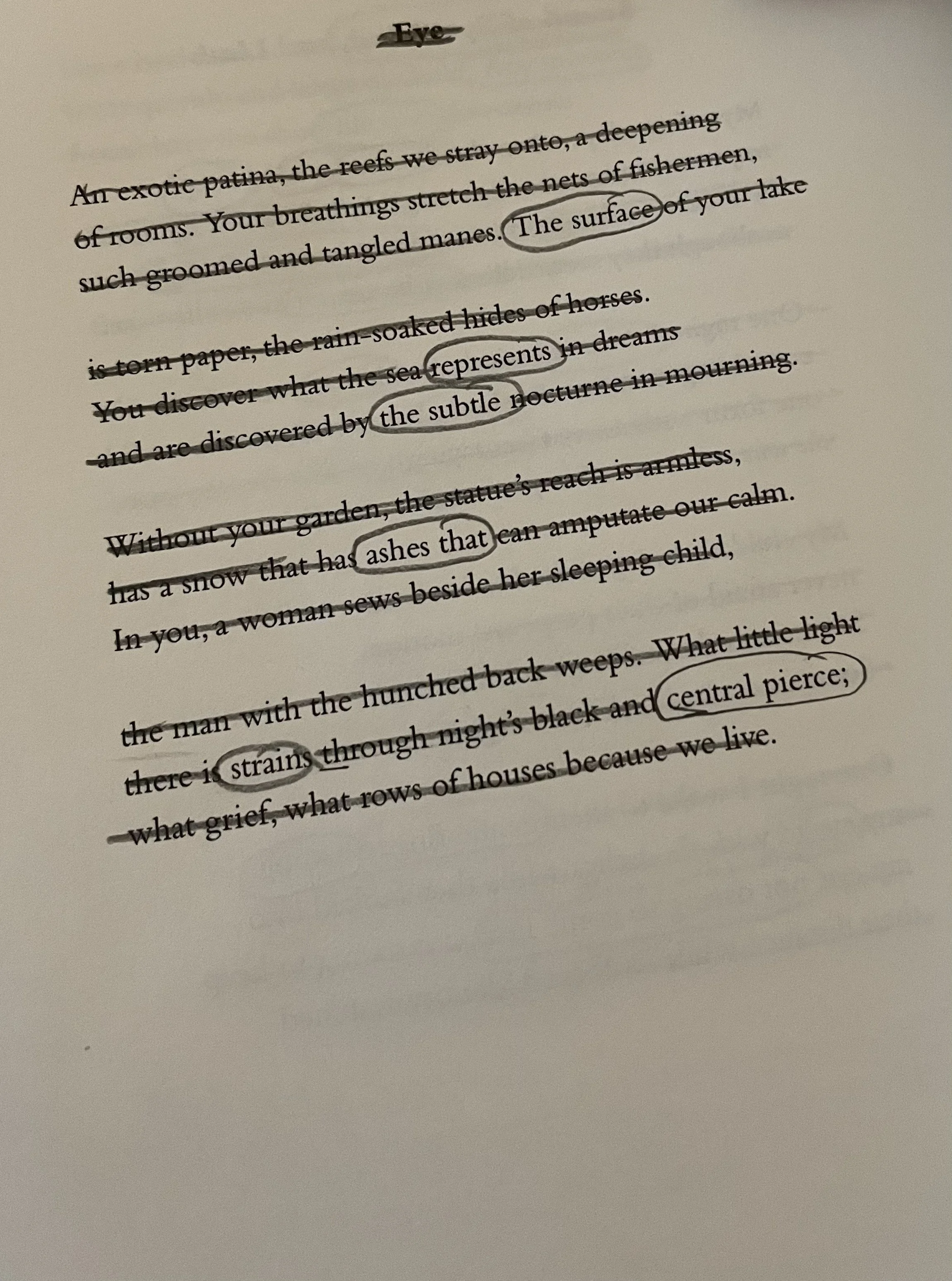
The found text reads:
The surface represents
the subtle ashes that strain–
central pierce.
Final Thoughts
In essence, the erasure technique is a political act not separate from the culture of violence and oppression. The technique does, however, allow the poet to engage in what Cythia Dewi Oka refers to as “the poetics of redaction and enlargement.” (A Tinderbox in Three Acts, footnote 18) The purpose is to amplify meaning and create space for discussion and dialogue. That said, the level of freedom and privilege a poet has regarding the technique can vary. Oftentimes the way a poet chooses to engage can provide insight into how much freedom they have or are trying to obtain.
Through the erasure process we can discover how much closer we are to each other, despite our differences. Those of us with privilege are much closer to those without than we realize. Erasure can reveal those power dynamics and provide us with insight into how we relate.


This article was published on March 16, 2026. Written by: